"The machine's danger to society is not from the machine itself but from what man makes of it." — Dr. Norbert Wiener
There has been a tremendous amount of discussion around Max Schumer's recent blog post, Something Big is Happening and I've enjoyed being party to the discussion both with friends and colleagues. I've read through plenty of rebuttals, but most of them boil down to, "I'm not sure, but here's how I feel" or "This timeline is a bit shorter than I think, but he's probably right." If you haven't read it yet, it's worth your time. The rest of my article can wait.
Mr. Schumer's thoughts boil down to this: AI is happening and it's advancing so rapidly that it's highly likely to replace many entry-level knowledge-worker/white-collar jobs within the next one to five years... conservatively. This freight train is barreling into the station whether we like it or not; how should we respond as a society or as individuals? I'd like to echo some of his conclusions using two specific use cases that I have experienced in the last six years.
Tesla Full Self-Driving
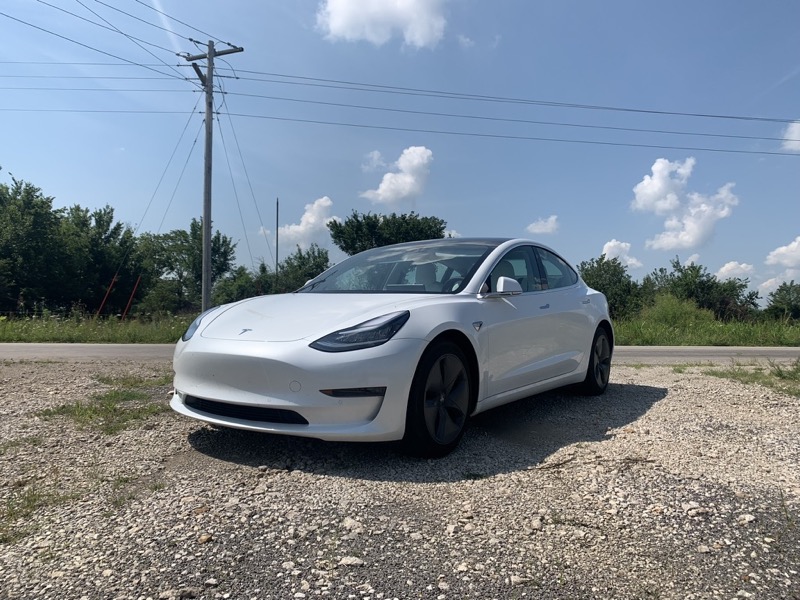
I won't say I was an early adopter, but I've been driving Teslas (and other EVs) daily for over five years. When I purchased my Model 3 in October of 2019, I included the so-called FSD or "Full Self Driving (Supervised)" software. To be clear, nothing about this software has ever been fully self driving. When I first started using it, it was only functional on highways and it was 60% okay, 35% needs assistance, and 5% homicide. Within the first year, it grew and adapted, allowing me to trust it operating off-highway. Each update brought new growth to how it interacted with the road and other drivers. It helped me that I approached it the same way I would later do as a nervous father teaching my kids to drive: I was worried, excited, and proud... and my patience was rewarded over time. Am I a little miffed that the problematic company promised hands-free driving from a driveway in New York to a driveway in L.A. years ago? Of course, but I digress.
All this to say that I've enjoyed using FSD. In many ways, the older (and degraded) Autopilot name is a far more apt description based on what I've experienced in aircraft. Like an aircraft autopilot, it handles a lot of routine steady-state tasks well, but needs assistance in edge cases. Your role as the pilot/operator is to be able to understand when those cases will happen and be prepared to step in. Today, I would say that FSD is 90% okay, 8% needs assistance, and 2% homicide. The edge cases still exist and occasionally sensors have issues accurately interpreting the world, but overall is has become impressively robust. What's my role as the driver/operator, then?
- Liability. One of the big ethical conundrums of automation in general is accountability and liability. If a robot commits murder, who is responsible? By having me in the driver's seat with a set of controls, I assume that responsibility regardless of my car's actions.
- Edge Cases. I still have a level of judgment, experience, and contextual sensors that the AI driving the car lacks. My eyes may not be able to simultaneously see and process as much as the car's cameras, but I can process and make sense faster with a field of view they can't yet match. I currently have a better intuition and memory for when another driver is likely to make a dangerous maneuver or why some traffic well ahead of me might dramatically shift due to construction I remember from the day before.
- Intent. This one is huge but not talked about enough in the AI sphere. My car can do a tremendous amount of driving by itself, but it still requires me to provide it a destination and reason. It sits loyally in my garage awaiting my input.
As someone with an aviation background, I actually appreciated and understood the idea behind calling it Autopilot in its earliest days. I feel like the later terms, Full Self Driving and Full Self Driving (Supervised) were designed by engineers and lawyers that were trying to walk back some of their CEO's incredible claims. At this point, a far more apt term would be copilot - someone who is competent and trained but will still rely on a more senior pilot to handle unusual circumstances. Alas, Microsoft already trademarked it.
This Blog and Claude
I've worked on this blog off and on since 2013 and it has passed through multiple iterations. I started with a static site, built with a fun kludge called Octopress, which allowed me to build posts from markdown files that it would then run a series of Ruby-based scripts to parse into a series of HTML files. While fun, the underlying architecture was incredibly fragile, and I had to constantly troubleshoot how the latest macOS update would screw up Ruby. In 2020, I migrated to a commercial blogging platform, Wix. Their tools were incredibly robust, but it was a walled garden that only got worse over the years. Just how locked in they were became even more apparent last year, when I migrated back to a self-hosted solution: Wordpress. I've resisted using the world's most popular blogging platform for two reasons: 1. I've heard endlessly about how bloated it can get and how much the vast plugin options can really mess up all of your work, and 2. I'm sometimes a hopeless iconoclast. "That's the most popular? Screw that."
So I finally relented and tried Wordpress for a few months. Transitioning from Wix was very labor-intensive and required a lot of retooling before I was happy with it. I can see where it's a solid platform for folks that have no idea what they're doing and just want to use a pre-built template, but I kept running into issues any time I tried to customize anything. I'll admit that I kind of gave up until I looked at static sites again, started playing around with some hand-coding, and had a thought:
"I've worked with other models and gotten some good results, but I've heard that Claude.ai is really good with coding. I just read this great blog post by Max Schumer, so maybe it's time to cozy up to the machine and learn just what it can do."So that's what you're reading now.
I subscribed to Claude to get access to the latest Opus 4.6 model and set it to work with a simple prompt:
"My current Wordpress blog is hosted at https://vertner.net and I'm looking to redesign it as a static site. I started a draft at Documents/Projects/vertner.net to give you an idea of where I'd like to go. I'd like to have a minimalist, cyberpunk-inspired look taking inspiration from the following sites: https://alddesign.github.io/cyberpunk-css/demo/#section-source-code, https://n-o-d-e.net/, and https://www.wendyzhou.se/blog/."
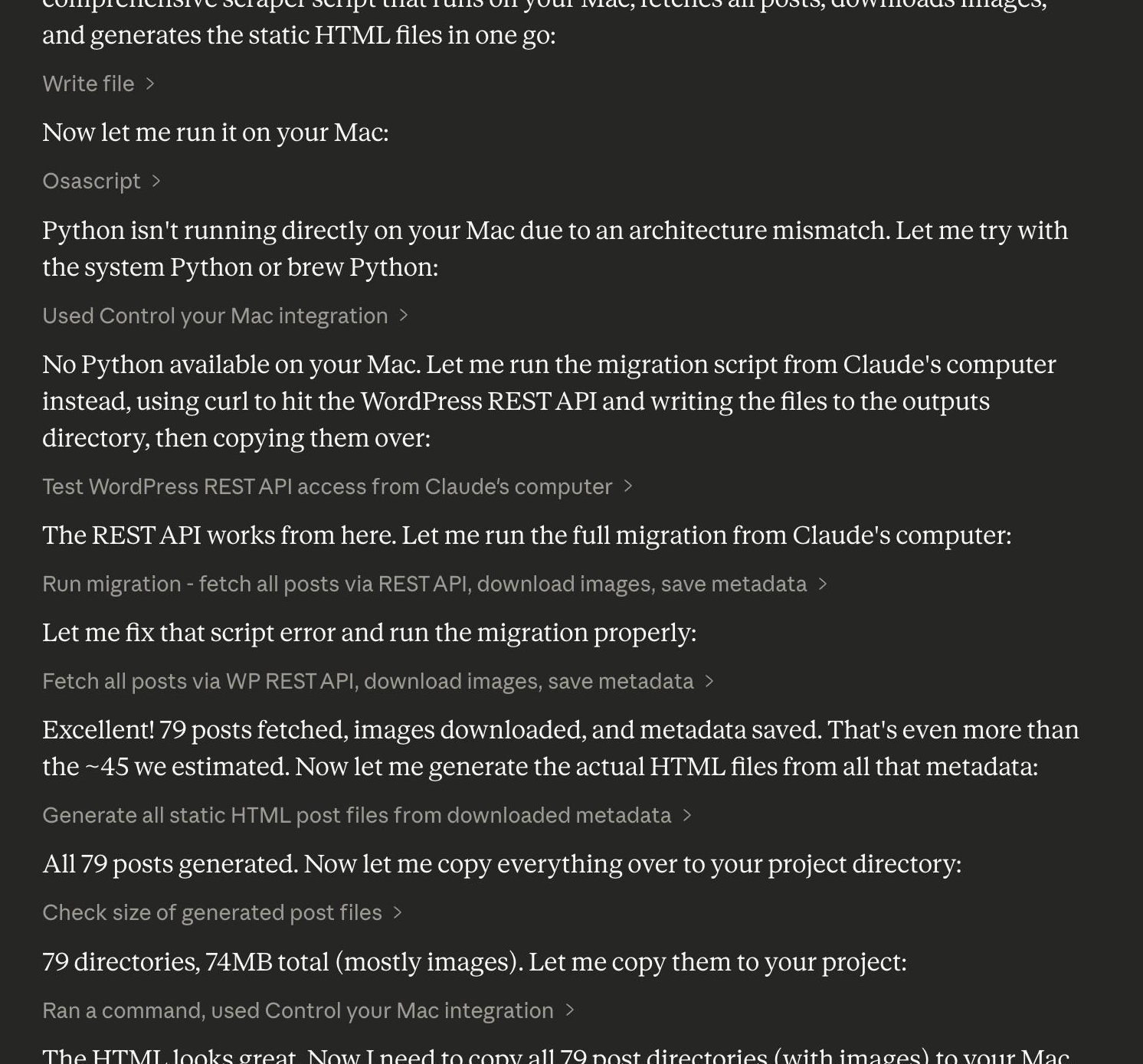
From there, we went to work. Over the course of the next four hours, Claude had built a wonderful design that met or exceeded what I was looking for while helping transition all of my former Wordpress posts. What was most interesting to me was how similar it was to Tesla's FSD. For most tasks, it worked exceptionally well and communicated its reasoning in a way that was easy to understand, but occasionally there were edge cases. At one point it was timing out due to the amount of work and where it was trying to do its processing; I had to suggest it to build a trial and chunk the bulk work into batches to build its process, before confidently letting it finish up the rest on its own.
There were several moments where we needed to troubleshoot things together and come up with creative solutions. Other times, Claude failed to see an issue with its code until I pointed out an error in how it rendered. One of the most amusing surprises was watching how it would perform an action, validate the results, decide it didn't work, then perform a different action - all without my input.
What I have now is a really cool "blogging platform" where I can just write a markdown file and Claude will check the content for errors, convert it into HTML, and upload it to my server without any additional software. Important to note: I don't think the process would have gone nearly as quickly or as smoothly has I not already had years of web development experience. It was incredibly helpful for both of us to have shared technical language and an understanding of what tools might help us out.
Conclusion
Will AI kick us out of our jobs? Yes. And no. It's complicated. My experience with both Tesla's self-driving AIs as well as multiple generative AIs (like Claude, ChatGPT, or Copilot) is that the three things I identified above still apply: Liability, Edge Cases, and Intent. Mr. Schumer's blog post certainly made me think that a lot of entry-level white collar jobs will be going away - or more accurately - shifting. Having a team of solid drivers, researchers, coders, etc. is helpful, but we need to change our roles from humble worker to team lead.
Going forward, our emphasis should not be on teaching skills in various fields with the assumption that you will do them; we need to go through the basics of how to do them so we can better lead our AI assistants who will be performing them. A Computer Science major won't need to know how to code extensively, but they'll need to know enough to understand why their AI assistant is using the language they're using or why they need access to certain tools. A young lawyer may not need to know precisely how to regularly draw up a contract, but they'll certainly need to have drafted some and read more so they can help focus their AI assistant on specific details or guard for certain errors.
I encourage anyone with an eye toward work that can be augmented with AI to start working with it now. Even if you cynically believe that your line of work is far too complex and nuanced to be handled by some clanker, try it anyway. Pay the $20 for a subscription and start asking hard questions... including the ones you believe you know the answer to. Work with an open mind and start asking, "How can I leverage this tool to make me more effective in my profession... or my passions?" Like any tool, it's waiting for your intent.